
Service areas
Roofing contractor in Glendale, Arizona
A lot of Glendale was built well before the neighbourhoods further out, which puts a great many roofs here past the point where the layer under the tile is still doing its job.
The housing stock
Older stock, and what that means underneath
Much of Glendale went up well before the newer growth on the edges of the Valley, and that shows up on the roof rather than in the street. The homes are established, well kept, and frequently carrying an underlayment that is simply out of time.
Fifteen to twenty-five years is a common range for what this climate does to an underlayment. That is a range for the material and the climate, not a prediction about a particular roof — but it is worth holding next to the age of a house that was built decades ago. A roof that has never been touched since it went on is not a roof that has been lucky; it is a roof that has not been looked at.
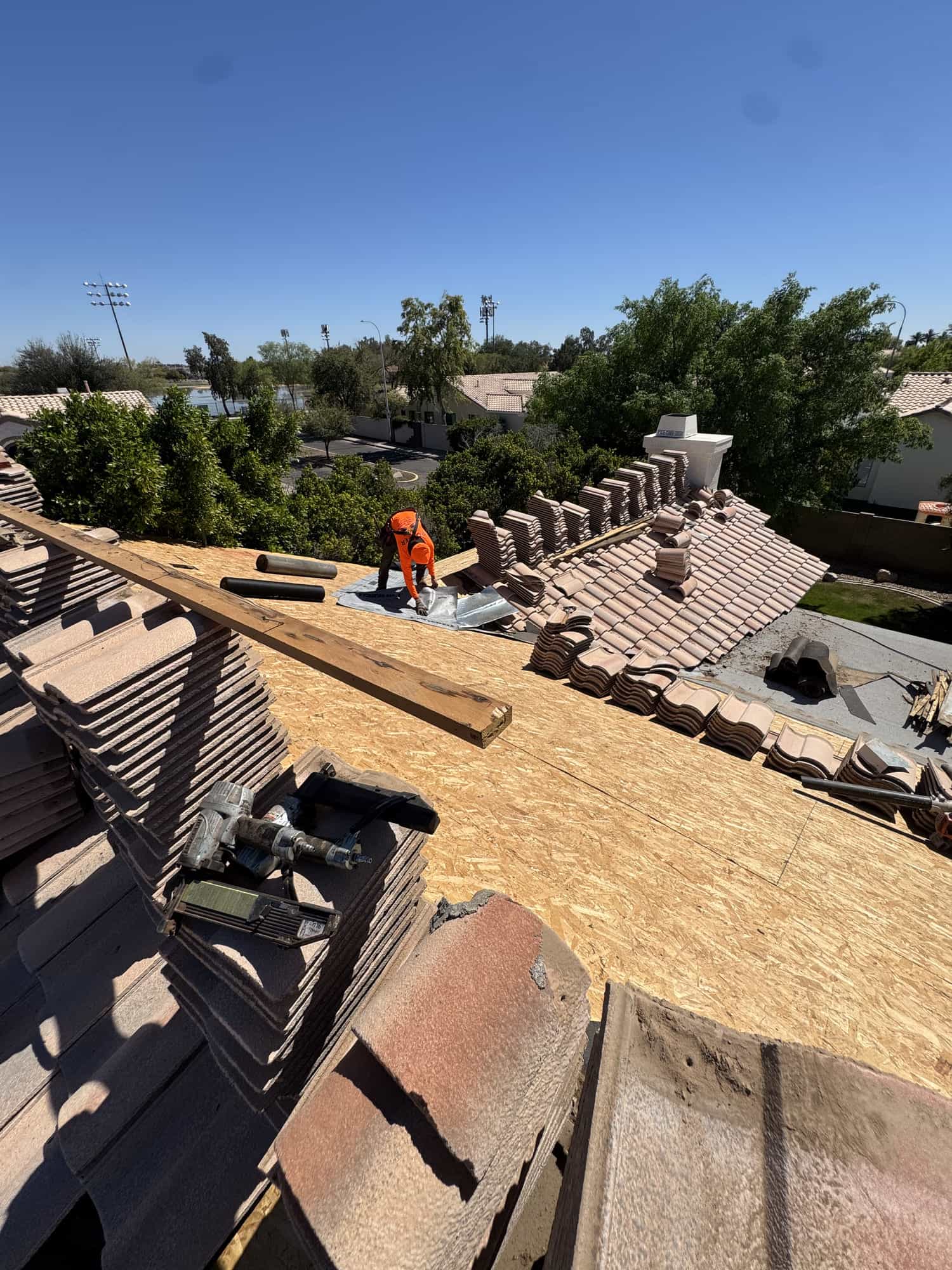
The tile above it, meanwhile, is very likely fine. Tile routinely outlives two or three underlayments, which is exactly why the age of the house is more informative here than the appearance of the roof.
The clock
What actually wears out, and in what order
There is very little freeze-thaw here. What ages a roof in the Valley is ultraviolet light, heat, and the daily swing between a roof deck well over 150°F in the afternoon and a cool night.
Underlayment goes brittle under that. Sealants and the rubber boots around pipes and vents dry, shrink and crack on the same clock, and they tend to go first — most of the leaks we find start at a penetration rather than in the middle of a slope. Flashing works loose because it is fastened to two materials that move differently, every day, for decades.
None of that is visible from the ground, which is the whole problem with an older roof. The failure is under the part you can see, and it announces itself as a stain on a ceiling some distance from where the water actually got in.
The decision
Old is not the same as finished
An older roof is not automatically a replacement, and we are not going to tell you it is because of the year on the house. Plenty of roofs in this city have real life left and need a boot, a section of flashing, or nothing at all.
What decides it is whether the failure is localised or system-wide. A discrete problem on a roof with life left is a repair. An underlayment at the end of its life across several slopes is not something a repair fixes, and paying to repair a roof with two years in it is usually money lost.
The way to know which one you have is to look — and looking is free, has no obligation attached, and leaves you with the photographs either way.
Questions
What Glendale homeowners ask us
My Glendale house is decades old and the roof has never been touched. Is that bad?
The tile looks fine on an old roof. Doesn't that count for something?
Does an old roof automatically need replacing?
Most relevant in Glendale
- Tile roofingOn an Arizona tile roof the tile is a sun shield. The layer actually keeping water out is the underlayment beneath it — and that is the part that wears out first.
- Residential roofingHouses across the Valley — leaks, storm damage, failed flashing, full replacement. We find the cause, not just the stain on the ceiling.
- Free roof inspectionHow every job here starts — the whole roof walked and photographed, findings explained before anyone talks about work or cost.
Book it in Glendale
Request a free inspection in Glendale
Tell us where the roof is and what you are seeing. A licensed contractor walks it, photographs it, and shows you the findings. Free, and no obligation.