
Services
Roof inspections
A licensed Arizona contractor walks your roof, photographs what's there, and shows you the findings — before anyone talks about work or cost. The inspection is free and there is no obligation afterwards.
The principle
The report has no prices in it
What you get is condition, findings, photographs and recommendations. What it does not contain is pricing, and that is deliberate.
The report is a diagnosis. Putting a number in it turns a factual document into a sales document, and homeowners can feel the difference immediately. Kept separate, you get something you can keep, compare, and show an adjuster — and any estimate that follows is about how to solve a problem you have already seen photographed and explained.
If you ask for a number on the roof, the answer is not evasion. It is: let us finish documenting what is actually wrong, and then we will walk you through the options.
The inspection
What gets looked at
The whole roof, not the one spot that prompted the call — because the spot that leaks is frequently not the spot that failed.
- Cracking from heat and temperature swing
- Granule loss, and brittle or lifted shingles
- Tile damage and underlayment deterioration
- Flashing failures, pipe penetrations, valleys and roof-to-wall areas
- Chimneys and skylights
- Ventilation — intake and exhaust, and whether they are balanced
- Ponding and drainage problems
- Fascia and decking damage, and any signs of water intrusion
The evidence
You should see it, not just be told it
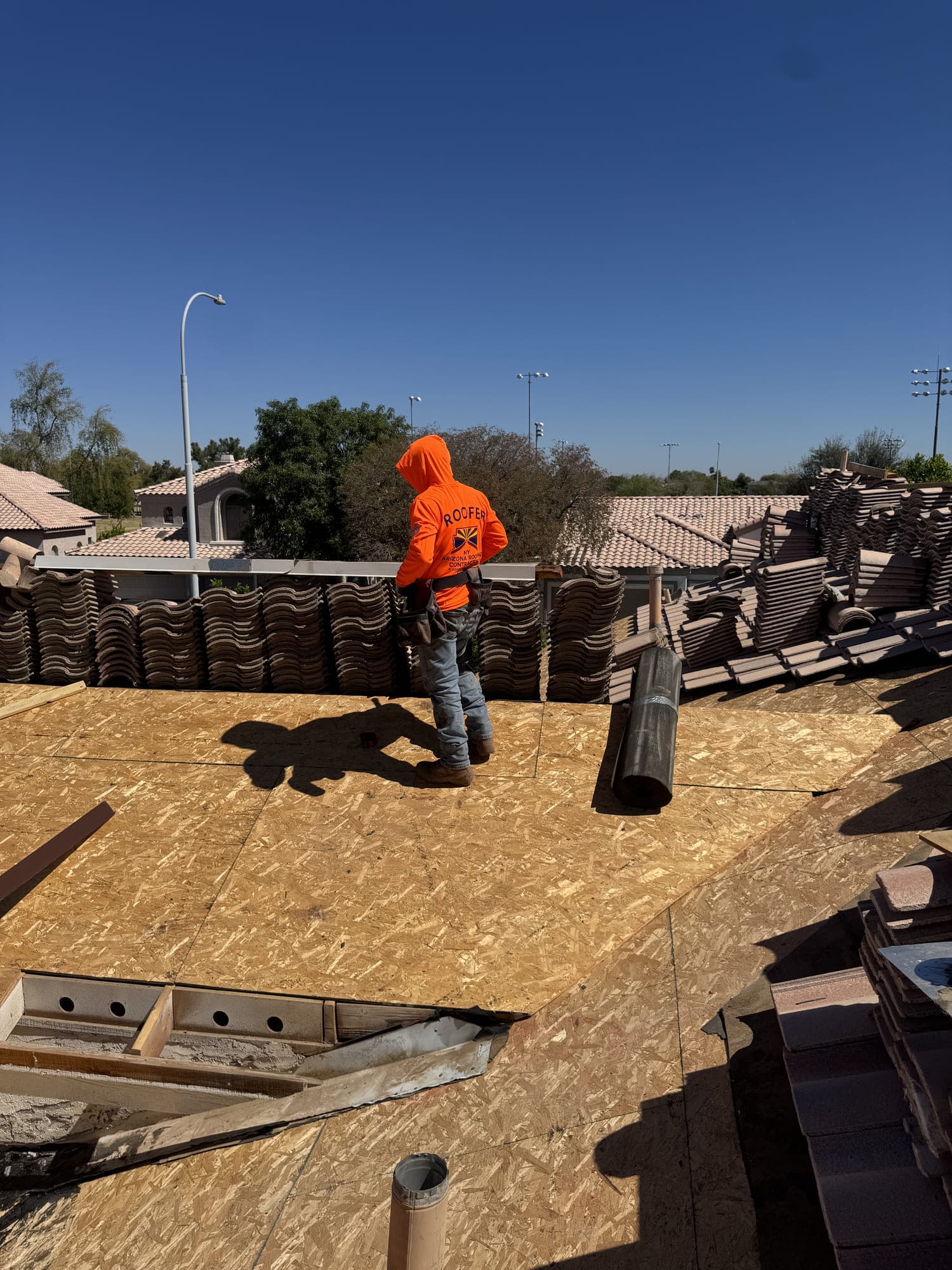
The photographs are the point. A wide frame of each slope before the close-ups, the defects, the areas that are working properly, and anything that affects safety or access. Wind damage is a pattern and a pattern only reads at a distance; a cracked boot only reads up close. Both go in.
The intent is closer to a doctor showing you the scan than to a contractor telling you what you need. You should be able to look at the evidence and take part in the decision — including the decision to do nothing yet.
Buying a house
Before you close on it
A general home inspection is not a roof inspection, and it is not meant to be. A home inspector covers the whole house and typically assesses the roof from the ground, from a ladder at the edge, or from inside the attic — which on a tile roof tells you almost nothing, because the layer that fails is under the tile.
That gap matters in Arizona more than in most places. A tile roof in immaculate condition from the street can be at the end of its waterproof life, and the difference between those two situations is the single largest number on the roof.
So it is worth having the roof looked at specifically, by someone who will walk it, before the inspection period closes. You get the photographs and the findings, and what you do with them at the negotiating table is entirely your business.
Insurance
Where an inspection fits a claim
The roles on a claim are worth knowing before you are in one, because muddling them costs time. You file the claim — you own the policy and the claim number, and nobody can file it for you. The adjuster inspects and writes a scope. What we do is document.
Documentation is the part that is easy to be short of later. Wide, mid and close photographs of each slope, a written condition report, and a record of what the roof looked like on a particular date. If a scope gets written without any of that, it gets written from one person's visit on one afternoon.
What we will not do is tell you how your claim is going to go. Whether damage is covered, and what your deductible does, is between you and your carrier — any roofer who tells you the outcome before your carrier has is guessing, and it is not their guess to make. What we can do is make sure the condition of the roof is on the record.
After a storm
When the monsoon has been through
The useful thing to know is that a roof damaged by a microburst usually looks fine from the driveway. Wind here lifts and shifts rather than carries away — tile moves an inch, a shingle's seal breaks and the shingle lies back down in the afternoon heat. What that storm did tends to show up as a leak during a later one.
So the answer to "should I get it looked at, it seems okay" is generally yes, and sooner rather than at the end of the season. It costs nothing and it is a great deal easier to establish what a storm did close to when it happened.
Questions
The ones we get asked about this work
Is it really free?
How long does it take?
Do I need to be home?
What if the roof is fine?
I am buying a house and the home inspection covered the roof. Is that enough?
Will the report help with an insurance claim?
Everything else we do
Request an inspection
Find out what your roof actually needs
Tell us where the roof is and what you are seeing. A licensed contractor walks it, photographs it, and shows you the findings. Free, and no obligation.