
Service areas
Roofing contractor in Peoria, Arizona
Subdivisions that went up together, which means roofs that reach the end of their life together — and a corner of the Valley that takes the monsoon head-on.
The housing stock
A street built at once ages at once
Much of Peoria arrived as whole subdivisions rather than house by house — a street, or several, built in one push, to one specification, with one crew, on one set of materials.
The consequence shows up decades later and it surprises people: roofs on a street like that tend to reach the end of their service life at roughly the same time. When a neighbour has work done it is not necessarily a sign that they were unlucky, and when three houses on a street get new roofs in a year, that is usually the calendar rather than a coincidence.
It is a genuinely useful thing to know as a homeowner, because it means the question "is it my turn" has a better answer than a guess. If the houses around you are the same age and the same build, what is happening to their roofs is real information about yours.
Storm season
The monsoon does not arrive evenly
Arizona's monsoon runs roughly July through September, and wind is the main actor rather than rain. Microbursts are short, violent downdrafts that lift edges and slide tile, and the damage often shows on one slope only — the one that faced the burst.
Two things about that make it easy to miss. The damage is directional, so a roof can be genuinely hurt on one side and untouched on the other. And it is subtle: wind here lifts and shifts rather than carries away, so tile moves an inch and a shingle's seal breaks and the shingle lies back down in the afternoon heat. From the driveway, nothing happened.
What that storm actually did tends to introduce itself during a later one. Which is the argument for looking after a season rather than after a leak — it costs nothing and it is a great deal easier to establish what a storm did close to when it happened.
What to watch
The things worth a look after a season
None of these require going up on the roof, and none of them are conclusive. They are the signs that make an inspection worth booking rather than deferring:
- Tile that has visibly moved, or a line of tile sitting differently from its neighbours
- Debris, granules or pieces of tile in the yard or against the fence after a storm
- Granules collecting in a downspout years into a roof's life
- A stain on a ceiling or in a corner that was not there last summer
- Daylight visible in the attic, or insulation that is damp or matted
- Neighbours on the same build having roof work done
Questions
What Peoria homeowners ask us
My neighbours are having their roofs done. Does that mean mine is due?
A storm came through and the roof looks fine. Is it?
Should I wait until after monsoon season to have it looked at?
Most relevant in Peoria
- Residential roofingHouses across the Valley — leaks, storm damage, failed flashing, full replacement. We find the cause, not just the stain on the ceiling.
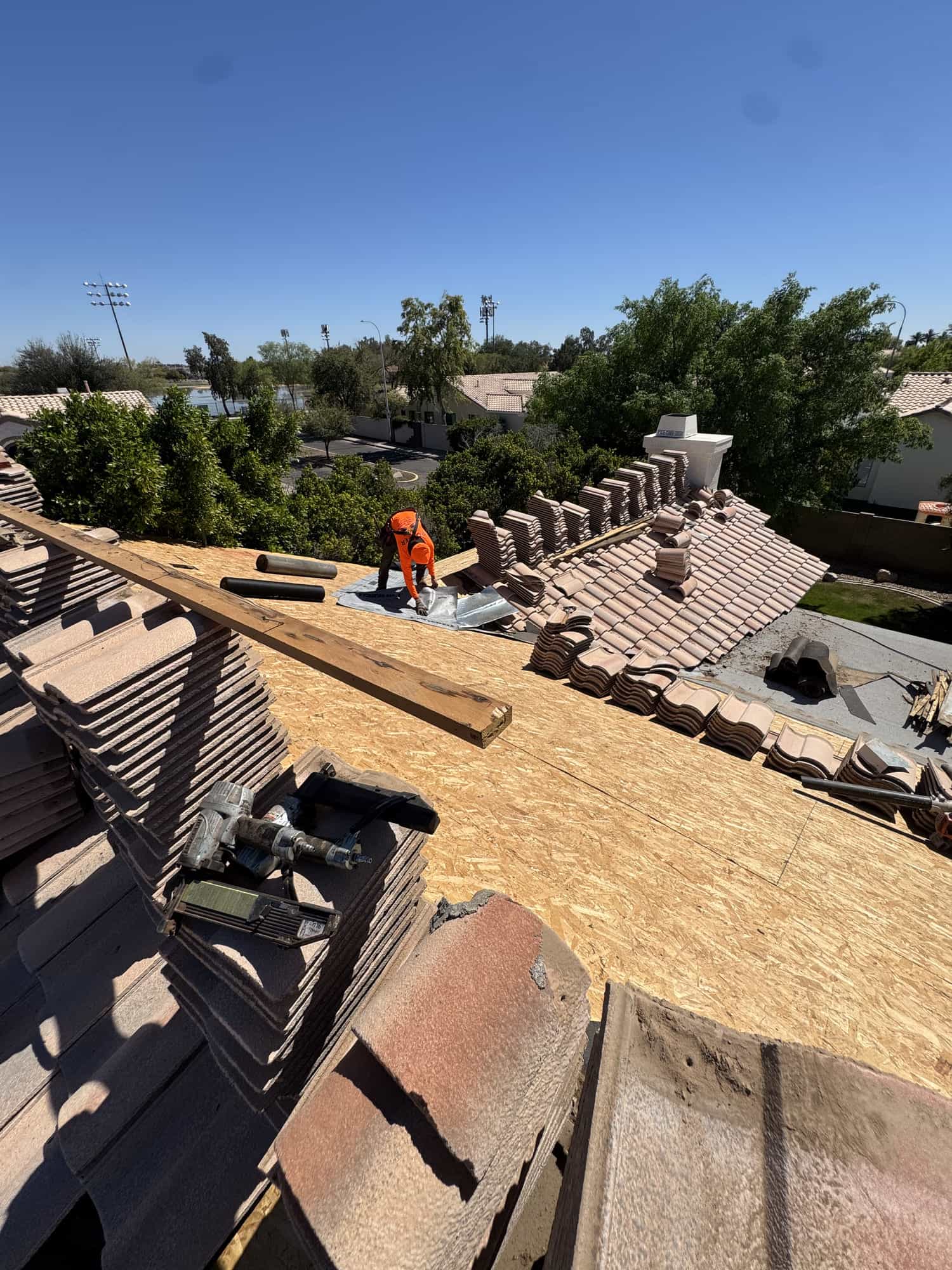
- Tile roofingOn an Arizona tile roof the tile is a sun shield. The layer actually keeping water out is the underlayment beneath it — and that is the part that wears out first.
- Free roof inspectionHow every job here starts — the whole roof walked and photographed, findings explained before anyone talks about work or cost.
Book it in Peoria
Request a free inspection in Peoria
Tell us where the roof is and what you are seeing. A licensed contractor walks it, photographs it, and shows you the findings. Free, and no obligation.