
Resources / FAQ
Roofing questions, answered straight.
The questions we get asked on the phone, written down — including the ones where the honest answer is that your roof is probably fine. Serving Phoenix & Maricopa County.
Answers
Ten questions, answered the way we answer them on the phone
There's a stain on my ceiling. Does that mean I need a new roof?
Usually not — and nothing about the stain will tell you either way. Water travels once it is inside, so where it shows up on a ceiling is often nowhere near where it got in. Finding the entry point means going up and looking. A small repair and a full replacement look exactly the same from underneath.
A monsoon storm came through. How do I know if my roof was damaged?
From the ground, mostly you don't, and that is the problem. Monsoon damage here is wind damage — a microburst lifts and shifts tile, works at flashing, and moves things an inch or two rather than carrying them away. The roof looks untouched from the driveway. What that storm actually did tends to show up as a leak during the next one.
My tile roof looks perfect. Isn't that the point of tile?
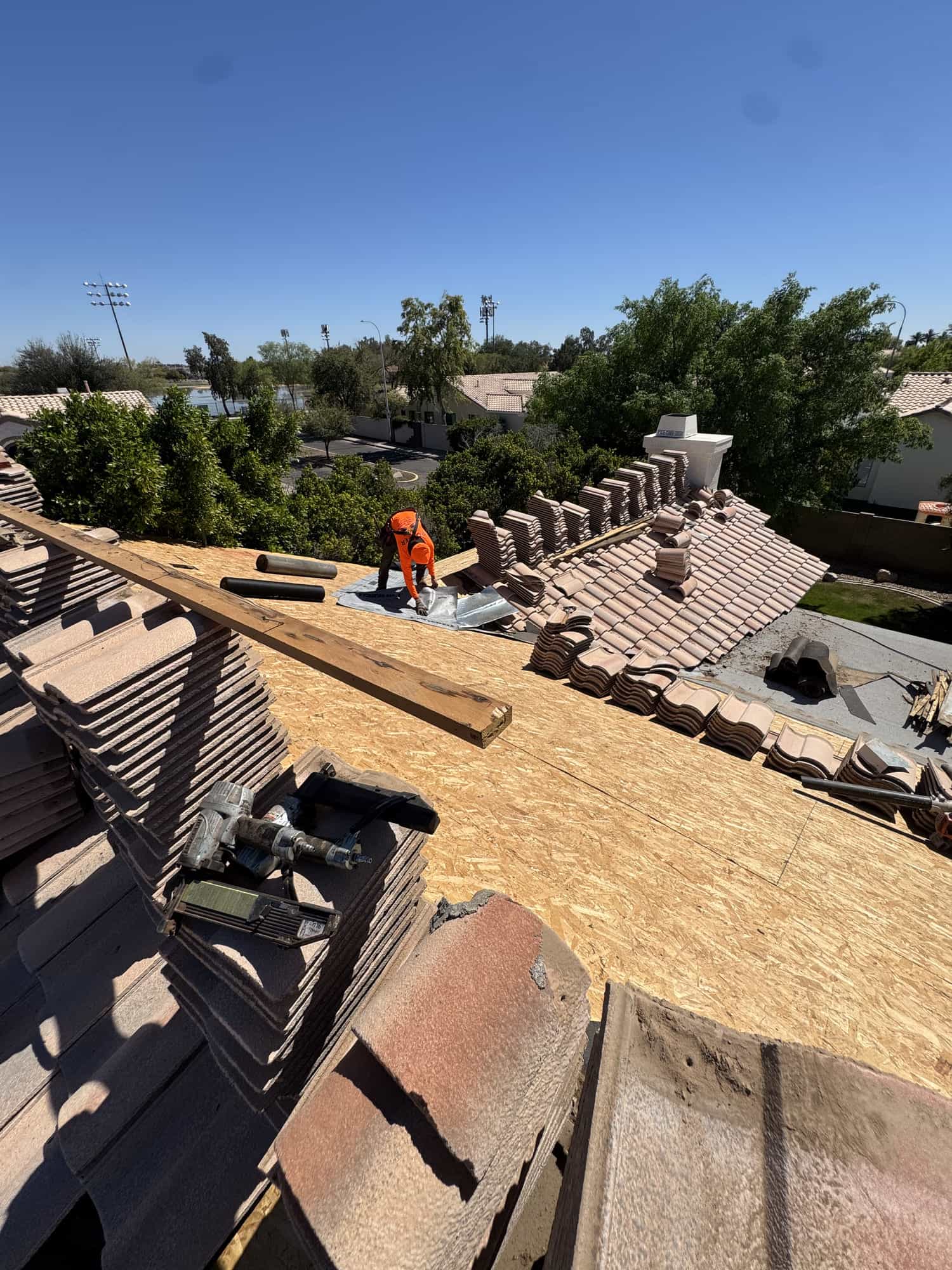
Tile is the armour, not the waterproofing. What keeps water out is the underlayment beneath it, and that is the layer Arizona sun works on — heat and UV make it brittle while the tile above it looks exactly as it did the day it was laid. A tile roof can be at the end of its service life with nothing at all wrong with the tile.
How long should underlayment last in Phoenix?
It depends on the material, how much sun that slope takes, and how well the attic underneath it breathes. Fifteen to twenty-five years is a common range for this climate. What yours has left is a question for an inspection rather than for an average.
What actually happens on the free inspection?
We walk the whole roof and photograph it — a wide frame of each slope first, then close-ups of the defects, and of the parts that are working properly. Then we go through the photographs with you. It is closer to a doctor showing you a scan than to a contractor telling you what you need.
Is it really free? What's the catch?
It is free and there is no obligation afterwards. The nearest thing to a catch is our reasoning: most people who see clear photographs of their own roof make a sensible decision about it, and often enough that decision is to do nothing yet. We would rather be the company you call when it is time.
How long does a reroof take?
Most houses are a matter of days rather than weeks. The real variables are the size and pitch of the roof, what we find once the old material is off, and the weather. You get the expected schedule for your roof after the inspection — a timeline offered over the phone by someone who has not seen it is a guess.
I think I have an insurance claim. Do you handle that?
We can document what is there. The photographs from an inspection are the same kind of evidence an adjuster works from, and they are yours to give your carrier. What happens after that is between you and them: the decision on a claim is the insurer's, and any roofer who tells you the outcome in advance is telling you something they cannot know.
One tile is cracked. Is that urgent?
Not urgent, but not nothing. A broken tile leaves the underlayment beneath it exposed to direct sun, which is the one thing that ages it fastest. It is a small job now and a larger one later. It is also worth finding out how it cracked — most of the broken tile we see was stepped on.
My roof is flat. Does any of this apply?
Yes, but the failure points move. Flat and low-slope roofs give way at seams, at penetrations and where the roof meets a parapet wall, rather than across the open field — and water standing after a monsoon is the thing to watch for. Same inspection and the same photographs; a different list of places to look.
How do I check that a roofer is actually licensed in Arizona?
Roofing contractors here are licensed by the Arizona Registrar of Contractors, and every licensed contractor has a number you can look up. Ours is ROC 359226. You can search the register yourself at roc.az.gov — by licence number or by company name — and it will show you the licence status and classification. It is worth doing for any contractor who knocks on your door after a storm, and it takes about a minute. Worth knowing too: a licence says a contractor is registered and bonded. It is not a warranty, and it is not a statement about the quality of anyone's work. Arizona Registrar of Contractors ↗
Does homeowners insurance cover a roof leak?
It depends what caused it, and your policy is the only authority on your policy. As a general shape, policies commonly treat sudden accidental damage — a storm, something falling on the roof — differently from deterioration, age, and lack of maintenance, and the second group is usually the homeowner's own responsibility. That is why the cause matters so much and why guessing at it from a ceiling stain is a poor idea. What we can do is document the condition of the roof with photographs, which is the same kind of evidence an adjuster works from. What nobody can honestly do is tell you in advance how your carrier will decide.
When is the best time of year to replace a roof in Phoenix?
There is no closed season here — the work happens year round, which is one of the advantages of a climate with almost no freeze. The real considerations are practical. Summer work starts early in the day because of the heat. Demand climbs in the run-up to monsoon season as people try to get ahead of it, and climbs again straight after a storm. And a roof replaced before the season is a roof that does not spend the season leaking. The genuinely best time is before you need it, which is an argument for finding out where yours stands rather than for a month on the calendar.
How often should a roof be inspected in Arizona?
Once a year is a sensible rhythm for most homes, and the monsoon is the natural anchor for it — before the season to clear drainage and catch anything loose, or after it to see what the season did. Beyond that there are three occasions worth not skipping: after any notable storm, before you buy a house, and any time you see something change indoors. Older roofs earn a closer eye than that, and if the houses around you are the same age and build and their roofs are being replaced, yours is worth a look.
Why does a tile roof leak when none of the tile is broken?
Because the tile is not where a tile roof leaks. Water gets in at the details: the rubber boots around plumbing vents, which crack in the sun; the flashing where the roof meets a wall, a chimney or a skylight; the valleys, which carry the most water on the roof; and the transition where a tile slope meets a flat section over a patio or an addition. Underneath all of those sits the underlayment, which is the actual waterproof layer and the one that ages out. Perfectly good tile sitting on a failed underlayment is an ordinary situation here, not an unlucky one.
Not the question you had? Ask it on the phone — we answer these all day, and nothing about asking commits you to anything.
Ask about yours
Still not sure what you're looking at?
That is what the free inspection is for. We walk the whole roof, photograph what's there, and show you the findings before anyone talks about work or cost.