
Services
Residential roofing
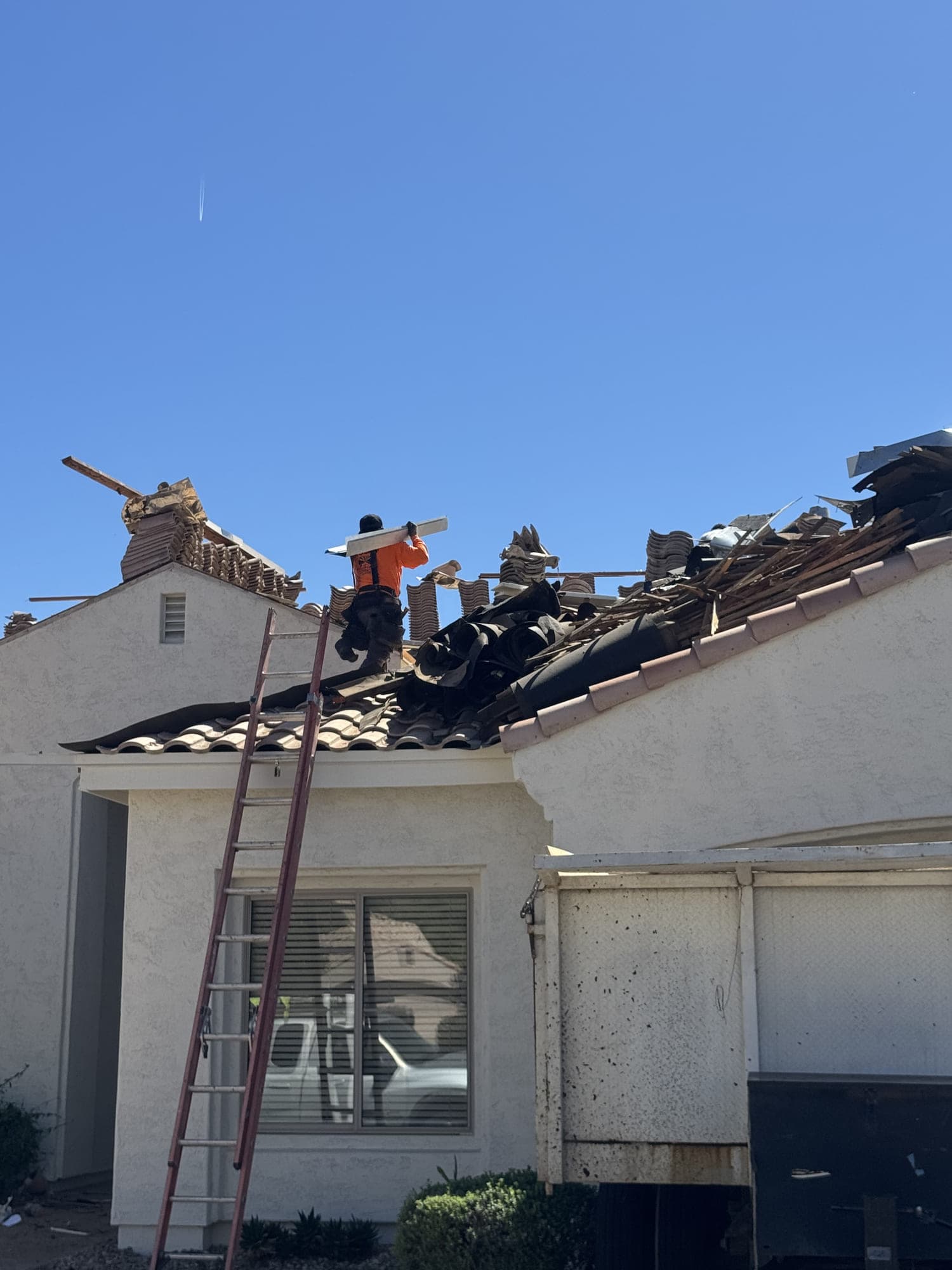
Houses across the Valley — leaks, storm damage, failed flashing, full replacement. We find the cause, not just the stain on the ceiling.
The approach
The diagnosis comes before the estimate
Every job starts the same way: a licensed contractor walks the whole roof, photographs what is there, and shows you the findings. Pricing is a separate conversation that happens afterwards, because a report with a number in it stops being a diagnosis and starts being a sales document.
That order matters most on a repair-or-replace decision. Repair makes sense when the damage is localised, the rest of the roof has real life left, and the cause is a discrete failure — a cracked boot, a section of flashing, storm damage on one slope. Replacement makes sense when the failure is age-driven and system-wide. The question worth asking out loud is whether you are fixing a problem or buying time on a roof that is already finished.
The climate
What actually fails on an Arizona house
Very little freeze-thaw, and a great deal of ultraviolet light and heat. Asphalt shingles lose the oils that keep them flexible, curl at the corners and shed granules. Tile underlayment goes brittle underneath tile that still looks new. Sealants and pipe boots dry out and crack.
The daily swing does as much as the peak. A roof deck well over 150°F in the afternoon and a cool night means every material on the roof expands and contracts, every day, for decades. Things that are fastened to something that moves differently — flashing against masonry, a metal vent against tile — work loose on that clock rather than in any one storm.
Which is why age matters more here than incident. Plenty of Valley roofs have never taken a notable storm and are still finished, and plenty that took a direct microburst are fine. What a roof has been through matters less than what the sun has been doing to it since it went on.
Where it starts
Most leaks begin where the roof is interrupted
Very few leaks are a hole in the middle of a slope. Almost all of them are at a place where the roof had to stop being a roof and meet something else. There are four usual suspects, and between them they account for most of what we find:
- Pipe boots — the rubber collar around a plumbing vent. Sun cracks the rubber, and on the south-facing side first. Extremely common, and a frequent cause of a ceiling stain.
- Flashing — chimneys, sidewalls, skylights, and anywhere the roof meets something vertical.
- Valleys — where two slopes drain into one path and carry the most water on the roof.
- Penetrations somebody added later — satellite mounts, solar standoffs, swamp cooler lines. A hole someone else made is a hole someone else sealed.
Reading a stain
The ceiling is the messenger, not the address
Water travels along decking and rafters before it drops. The mark on a ceiling is where it fell, not where it got in, and the two can be several feet apart — which is why we look in the attic whenever there is a way to get to it.
This is also why a repair aimed at the stain tends to come back. If the entry point was never found, the only thing that changed is the paint. Finding the cause is the job.
The walk
What we look at on a house
The whole roof, not the one spot that prompted the call — because the spot that leaks is frequently not the spot that failed. The findings get photographed as we go, and you get the photographs whether or not anything comes of it.
- Cracking from heat and the daily temperature swing
- Granule loss, and brittle or lifted shingles
- Tile damage and underlayment deterioration
- Flashing failures, pipe penetrations, valleys and roof-to-wall areas
- Chimneys and skylights
- Ventilation — intake low and exhaust high, and whether the two are anywhere near balanced
- Ponding and drainage problems
- Fascia and decking damage, and any signs of water that has already got in
The decision
Repair or replace, decided on evidence
Repair is the right answer more often than a homeowner braced for bad news expects. It makes sense when the damage is localised, the rest of the roof has real life left, and the cause is a discrete failure — a cracked boot, a section of flashing, wind damage on one slope.
Replacement is the right answer when the failure is age-driven and system-wide: the underlayment is at the end of its life, several slopes show the same wear, or the same roof would keep coming back for repairs.
The test worth saying out loud is whether you are fixing a problem or buying time on a roof that is already finished. Money spent repairing a roof with two years left is usually money lost, and a company that quotes a replacement for something a repair genuinely solves has stopped doing the diagnosis.
Questions
The ones we get asked about this work
How quickly does a roof leak need dealing with?
Can you just patch the spot where it is leaking?
My roof is old but nothing is leaking. Is there any point looking?
Do I have to decide anything on the day?
Everything else we do
Request an inspection
Find out what your roof actually needs
Tell us where the roof is and what you are seeing. A licensed contractor walks it, photographs it, and shows you the findings. Free, and no obligation.