
Services
Tile roofing
On an Arizona tile roof the tile is a sun shield. The layer actually keeping water out is the underlayment beneath it — and that is the part that wears out first.
The misunderstanding
The underlayment is the roof
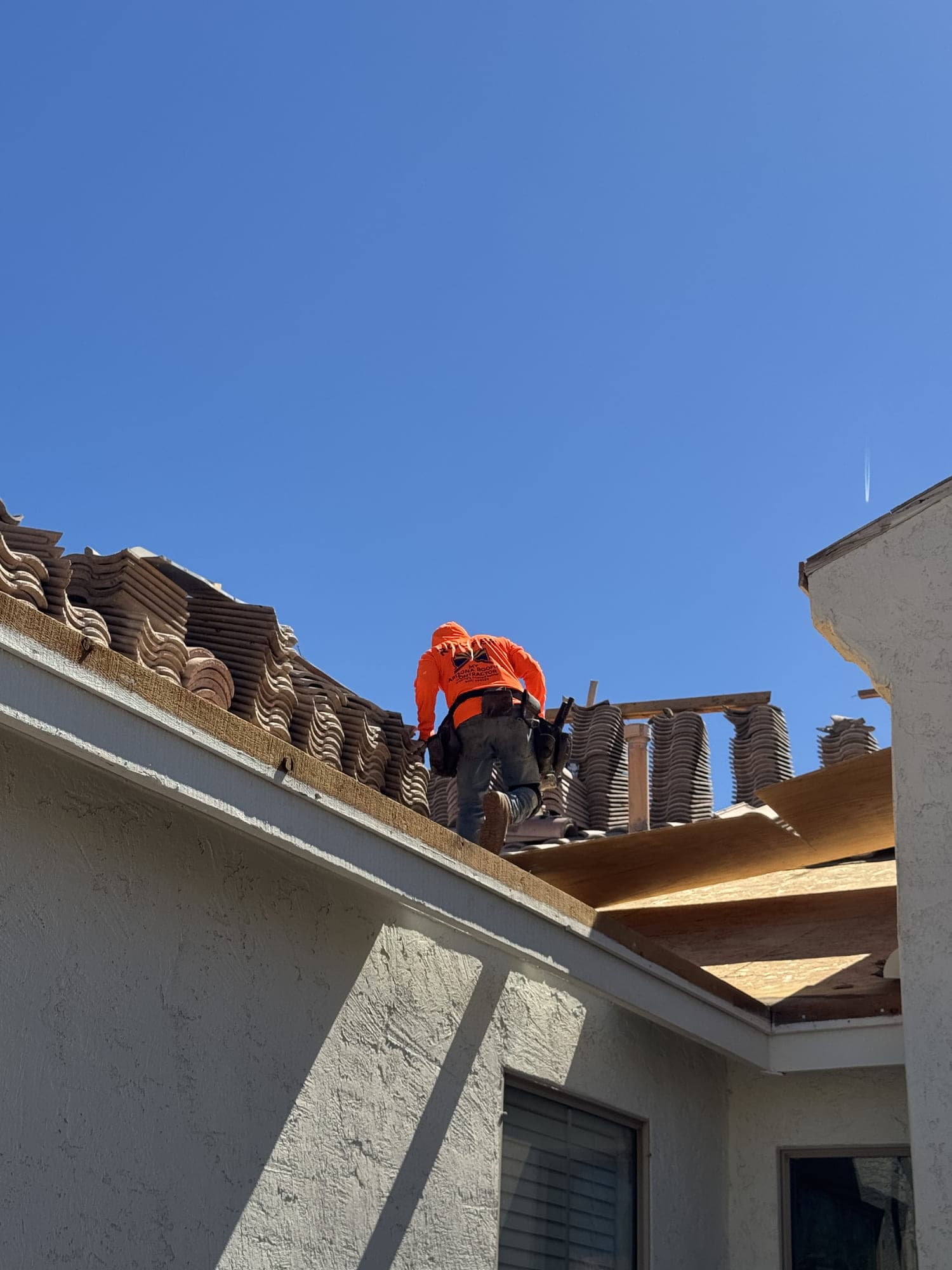
The most common thing we hear on a tile home is that the tile looks fine, so the roof must be fine. Concrete and clay tile are a rain shield and a sun shield. The waterproof layer is the underlayment beneath them, and tile routinely outlives two or three underlayments.
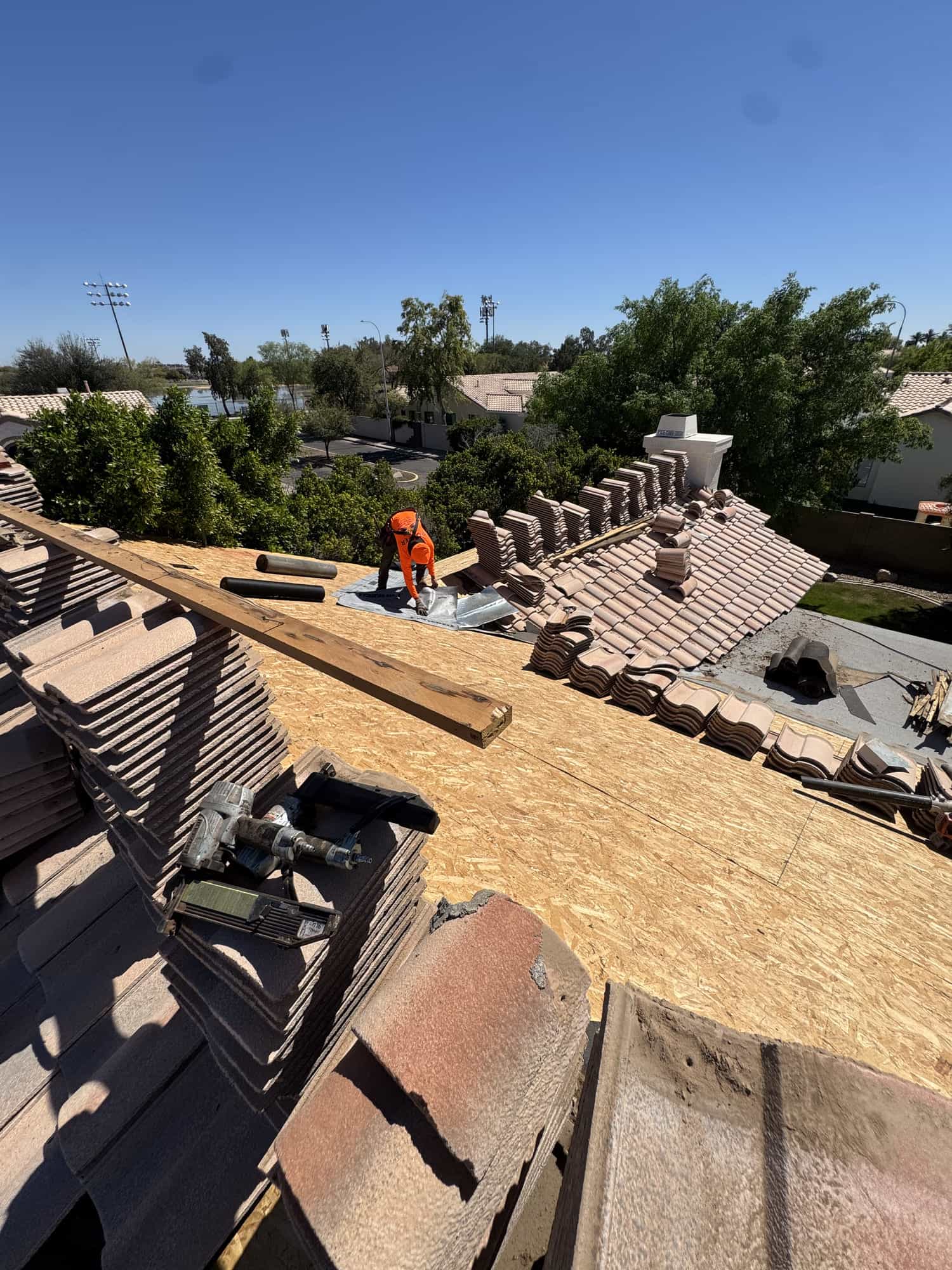
In practice that means a tile roof can need its underlayment replaced while nearly every tile on it is still perfectly good. The tile is lifted and stacked, the underlayment is replaced, and the same tile goes back down — only the cracked pieces need replacing.
It also means broken tiles matter more than they look. A cracked or slipped tile lets sun reach the underlayment directly, and that accelerates the failure underneath it.
The short version: on a tile roof, you are buying the layer you cannot see.
The climate
Why Arizona is hard on it
There is very little freeze-thaw here. What ages a roof in the Valley is ultraviolet light, heat, and the daily swing between a roof deck well over 150°F in the afternoon and a cool night.
Underlayment goes brittle under that. It is common for the tile itself to last fifty years or more while the layer underneath it reaches the end of its waterproof life in something closer to fifteen to twenty-five. That range is what this climate does to the material in general — not a prediction about any particular roof, which is what looking at it is for.
Sealants and the rubber boots around pipes and vents dry, shrink and crack on the same clock. Most of the leaks we find start at one of those penetrations rather than in the middle of a slope.
None of this is visible from the ground. A tile roof that looks immaculate from the street can be at the end of its waterproof life, because the part that fails is underneath the part you can see.
Storm season
What the monsoon actually does
Arizona's monsoon runs roughly July through September, and the damage pattern is not the one people expect from storm footage elsewhere.
Wind is the main actor. Microbursts produce short, violent downdrafts that lift edges and slide tile, and the damage often shows on one slope only — the one that faced the burst. Blowing dust packs into valleys and behind flashing, then holds water against materials designed to shed it. Rain rate matters more than rain volume: a short, hard downpour finds drainage that a slow rain never would.
Hail happens here, but less often than homeowners expect. A good deal of what gets called hail damage in the Valley turns out to be foot traffic, blistering, or age.
The inspection
What we look for on a tile roof
The inspection is a diagnosis, and it covers the whole roof rather than the one spot that prompted the call. On tile, these are the things that decide the answer:
- Cracked, slipped or missing tile — and what the sun has been reaching through the gap
- Underlayment condition, particularly at the eaves, in the valleys and at the transitions
- Flashing: chimneys, sidewalls, skylights, and anywhere the roof meets something vertical
- Pipe penetrations and the rubber boots around them, which crack on the sun-facing side first
- Valleys and drainage, including ponding where a flat section meets tile
- Ventilation — intake low and exhaust high, and whether the two are anywhere near balanced
- Fascia, decking, and any sign of water that has already got in
The transitions
Where the tile meets the flat roof
A great many Valley homes are not one roof but two — a pitched tile roof over the main house and a low-slope section over a patio cover, an addition or a garage. The two meet somewhere, and that junction is one of the hardest-working details on the building.
It is where water coming off a whole tile slope arrives concentrated at a roof that drains slowly, and where two different systems with different movement have to stay sealed to each other. When a tile home leaks and the tile turns out to be blameless, this is frequently the reason.
Reading a stain
Where a leak starts is rarely where it shows
Water travels along decking and rafters before it drops. The stain on a ceiling is where it fell, not where it entered, and the two can be several feet apart — which is why we look in the attic when we can get to it.
It is also why a repair aimed at the stain rather than at the entry point tends to come back. Finding the cause is the whole job; the ceiling is just the messenger.
Questions
The ones we get asked about this work
My tile looks fine. Do I still need it looked at?
Will I need all new tile?
Can I go up and check it myself?
How long should underlayment last in Phoenix?
Everything else we do
Request an inspection
Find out what your roof actually needs
Tell us where the roof is and what you are seeing. A licensed contractor walks it, photographs it, and shows you the findings. Free, and no obligation.